
Why ‘Soccer House?’
Our name is more than an on-the-nose description, it’s an homage to a unique place that is deeply rooted in the history of both the city of Chicago and American soccer.
Soccer House takes its name from the former headquarters of the U.S. Soccer Federation, which spent more than three decades in Chicago’s South Loop. Long before our bar began taking shape in West Town, “Soccer House” was the affectionate nickname for a very real place; one our owner knows well, having worked inside its walls for several years.
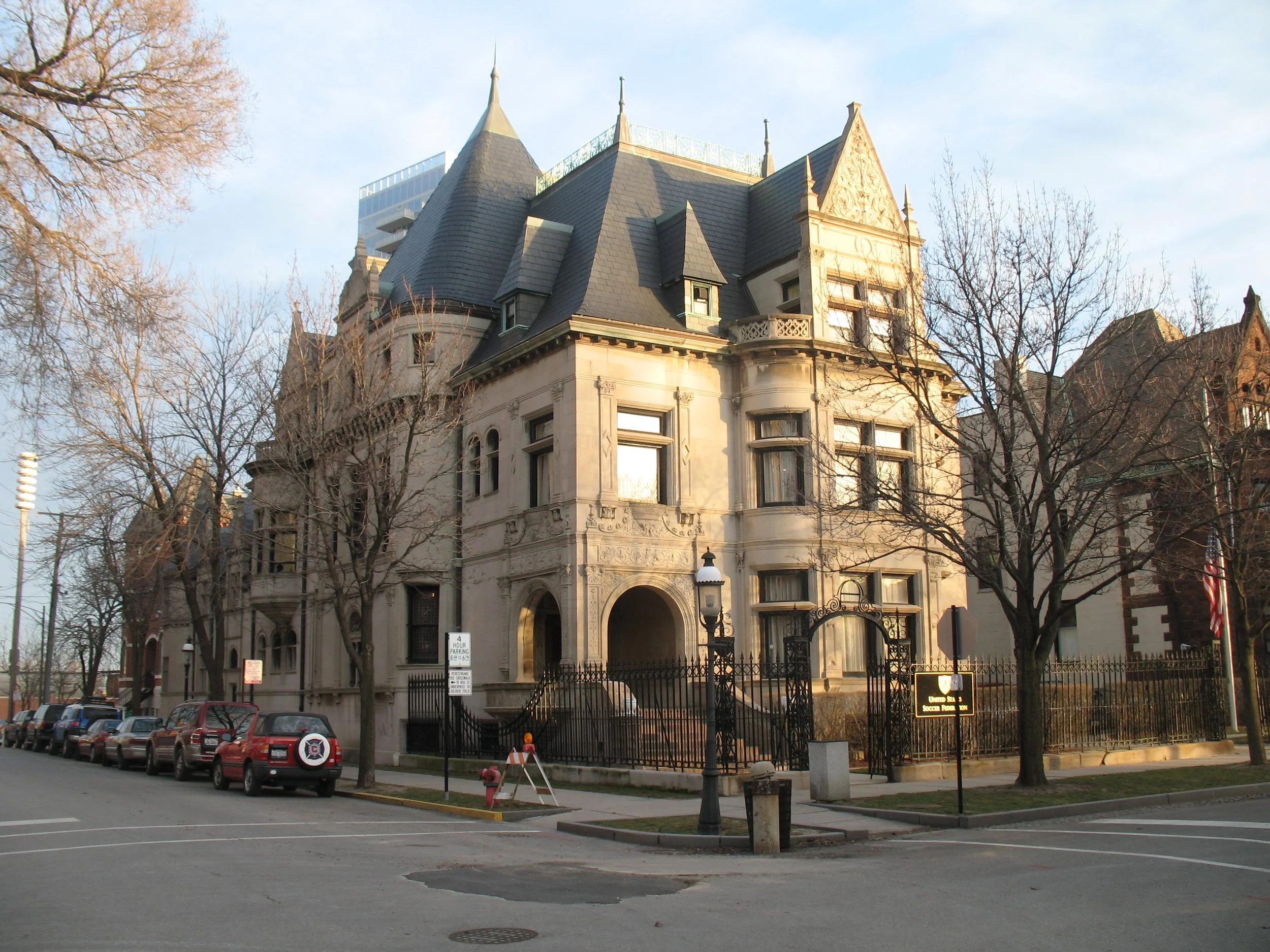
The stately Kimball House. One-half of the pair of mansions which made up the original Soccer House.
The Mansion
The original Soccer House wasn’t actually a single building, but two neighboring mansions on Prairie Avenue, among the last surviving remnants of Chicago’s Gilded Age “Millionaires’ Row.” Built in the late 1800s, these ornate homes were commissioned by men whose names helped define industrial Chicago. One was constructed for William Wallace Kimball, founder of Kimball Pianos and Organs. The other belonged to Joseph Coleman, president of a manufacturing company. Across the street once lived George Pullman of railcar fame, while nearby neighbors included Marshall Field and Philip Armour.
U.S. Soccer later captured the character of the Kimball House in its own write-up:
“Built of Bedford limestone and topped with a slate roof, the exterior consists of numerous large and small turrets, gables, balconies and ornamental iron-railed galleries. The interior is as extravagant as its exterior, with wood abundant throughout. Ceilings are beamed in oak and mahogany, and fireplaces made of onyx warm the parlor.”
The Legend
Those who worked in Soccer House remember it as a beautiful place with plenty of quirks. Its labyrinthine layout meant that getting from one part of the building to another could require a long walk and several staircases. Offices were shoehorned into spaces that were likely closets in a grander age, while shared workspaces appeared in rooms clearly never designed for desks. There was also an enormous safe in the basement that looked like it belonged in a bank vault.
Before arriving in Chicago, U.S. Soccer, like many Olympic sport federations, was based in Colorado Springs. In 1991, the Federation moved its headquarters to Chicago’s South Loop, settling into the Prairie Avenue mansions. Why Chicago? Why these buildings? The answer lies in a perfect meeting of two very familiar styles of dealmaking, long associated with both the city of Chicago and international soccer.
At the time, the City of Chicago owned the properties. In exchange for providing the buildings to U.S. Soccer, the city secured the opening match of the 1994 FIFA World Cup at Soldier Field. Call it a bribe, a kickback, a trade, or simply smart negotiating. Chicago got to kick off the biggest tournament in the world, U.S. Soccer got a home, and 35 years later a bar got its name.
There are also stories passed down from staffer to staffer, some more verifiable than others. Those around in the early 2000s will tell you about a fax machine that ran 24/7 for weeks when World Cup ticket applications were submitted by fax. There were even rumors of a marijuana-growing operation hidden away in the attic.
U.S. Soccer left the house in 2022, and the property was sold in 2023. The homage to this bygone place is fitting. Our Soccer House, like the one that served U.S. Soccer for decades, is meant to be a home for the game, for the people who care about it, and for all the stories that come with it.